
- High-performance CPU up to 1.8 GHz
- Memory: up to 8 GB ROM, 2 GB RAM, 64 KB MRAM RETAIN
- Linux OS with real-time patch
- Four Ethernet ports (three in a managed switch)
- Supported protocols: Modbus RTU/ASCII/TCP, OPC UA (Server), MQTT (client/broker), SNMP (Manager/Agent), utility meter protocols, custom protocol support
- GSM/GPRS modem compatibility
- Application protocols: NTP, FTP/FTPS, HTTP/HTTPS, SSH, SMTP/IMAP/POP3
- MySQL and MS SQL database connection
- CODESYS web visualization support
- Built-in web interface for configuration and diagnostics
- Easy connection to akYtec Cloud
- Dual power inputs for redundancy
- Ethernet ring topology support with Mx210 modules (STP/RSTP)
- Built-in firewall
- DIN rail or wall mounting
- Removable terminal blocks with captive screws
- Cable management system
- Replaceable CR2032 battery, Start/Stop switch, MicroSD slot under cover
- Wide power supply range: 10…36 VDC
- Extended operating temperature: −40…+55 °C
(−20…+55 °C for PLC210-1x)
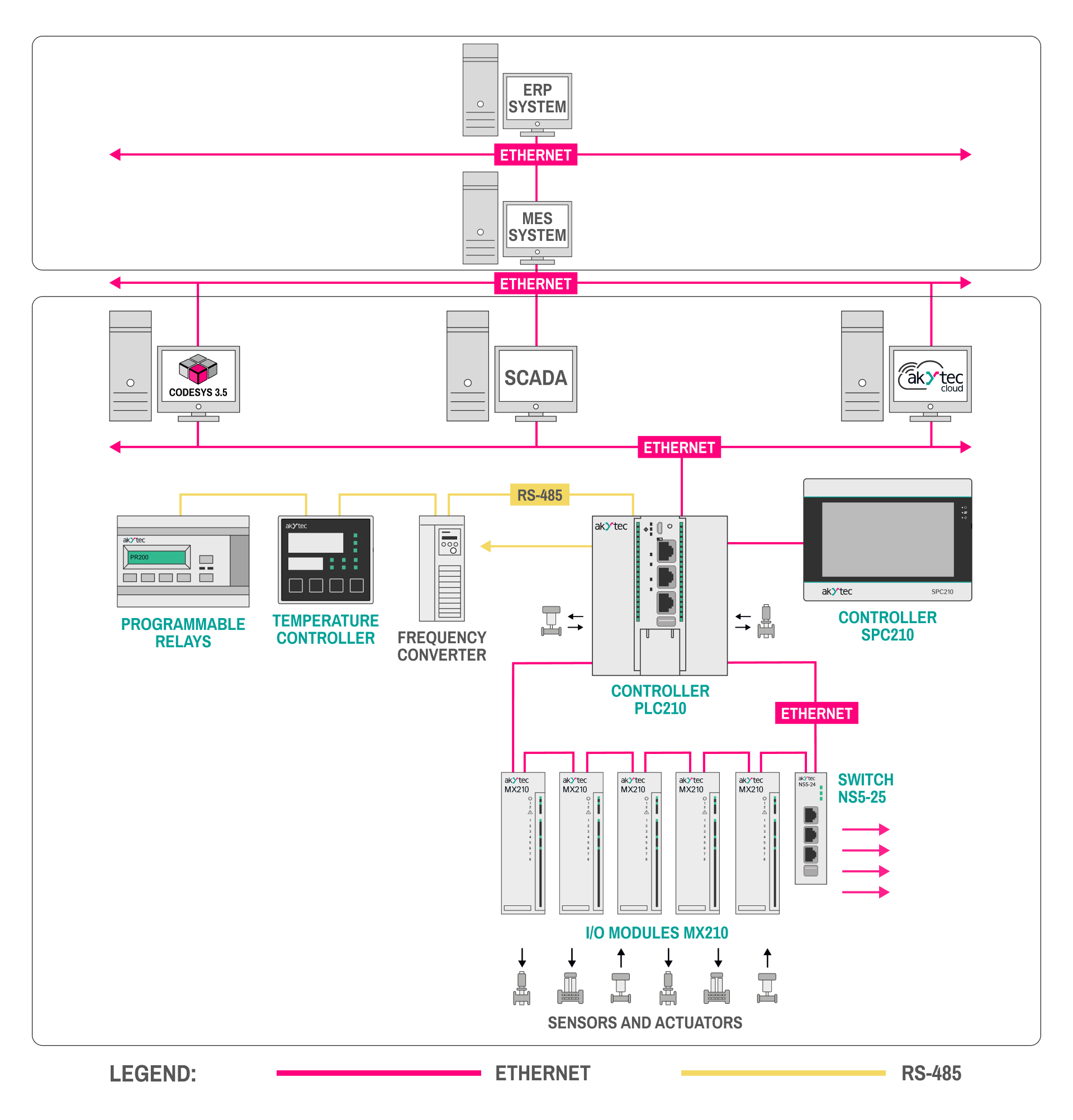
Functions and features:
|
Power supply |
|
|
Number of power ports |
2 (main and backup) |
|
Power supply |
10…36 V (nominal 24 V) |
|
Power consumption, max. – model 11 |
16 W |
|
Power consumption, max. – model 12 |
14 W |
|
Power consumption, max. – model 13 |
10 W |
|
Power consumption, max. – model 14 |
12 W |
|
Inverse-polarity protection |
Yes |
|
Appliance class |
II |
|
Computing resources |
|
|
CPU |
4× Cortex-A55, 1.8 GHz |
|
ROM |
8 GB (eMMC) |
|
RAM |
2 GB (DDR4) |
|
Retain memory |
64 KB (MRAM) |
|
Communication interfaces – Ethernet |
|
|
Number of ports |
4 (RJ-45) |
|
Ethernet configuration |
Ports 1–3: Ethernet switch, 10/100 Mbps Port 4: separate Ethernet network adapter, 10/100/1000 Mbps |
|
Industrial protocols* |
Modbus TCP (Master/Slave), OPC UA (Server), MQTT (Client/Broker), SNMP (Manager/Agent) |
|
Application protocols* |
NTP, FTP, FTPS, HTTP, HTTPS, SSH, SMTP/IMAP/POP3, OpenVPN, WireGuard |
|
Maximum cable length |
100 m |
|
Communication interfaces – RS485 |
|
|
Number of ports |
2 |
|
Industrial protocols* |
Modbus RTU (Master/Slave), Modbus ASCII (Master/Slave), akYtec (Master) |
|
Baud rate |
1200, 2400, 4800, 9600, 19200, 38400, 57600, 115200 bps |
|
Galvanic isolation |
1500 V |
|
Pull-up resistors |
Yes |
|
Terminating resistors |
No |
|
Communication interfaces – RS232 |
|
|
Number of ports |
1 (Tx, Rx, GND) |
|
Maximum number of devices |
1 |
|
Industrial protocols* |
Modbus RTU (Master/Slave), Modbus ASCII (Master/Slave), akYtec (Master) |
|
Baud rate |
1200…115200 bps |
|
USB Device |
|
|
Number of ports |
1 × micro-USB (RNDIS) |
|
Supported services |
CODESYS Gateway, FTP, HTTP, HTTPS, SSH |
|
Connected drives – USB Host |
|
|
Number of connectors |
1 × USB Type-A |
|
Supported devices |
MSD / FTDI, USB 2.0 |
|
Connected drives – SD card |
|
|
Number of connectors |
1 |
|
Type |
microSD |
|
Real-time clock |
|
|
Accuracy at +25 °C |
±5 s/day |
|
Accuracy at −20 °C / +55 °C |
±20 s/day |
|
Backup battery |
CR2032 |
|
General information |
|
|
Dimensions |
(105 × 125 × 84) ± 2 mm |
|
Weight |
max. 1.2 kg |
|
IP code |
IP20 |
|
Average lifetime, min. |
8 years |
|
Model |
DI (Digital Inputs) |
DO (Digital Outputs) |
AI (Analog Inputs) |
AO (Analog Outputs) |
|
PLC210-11 |
12 DI |
18 DO |
– |
– |
|
PLC210-12 |
24 DI |
12 DO |
– |
– |
|
PLC210-13 |
24 DI |
16 DO |
– |
– |
|
PLC210-14 |
12 DI |
12 DO |
4 AI |
– |
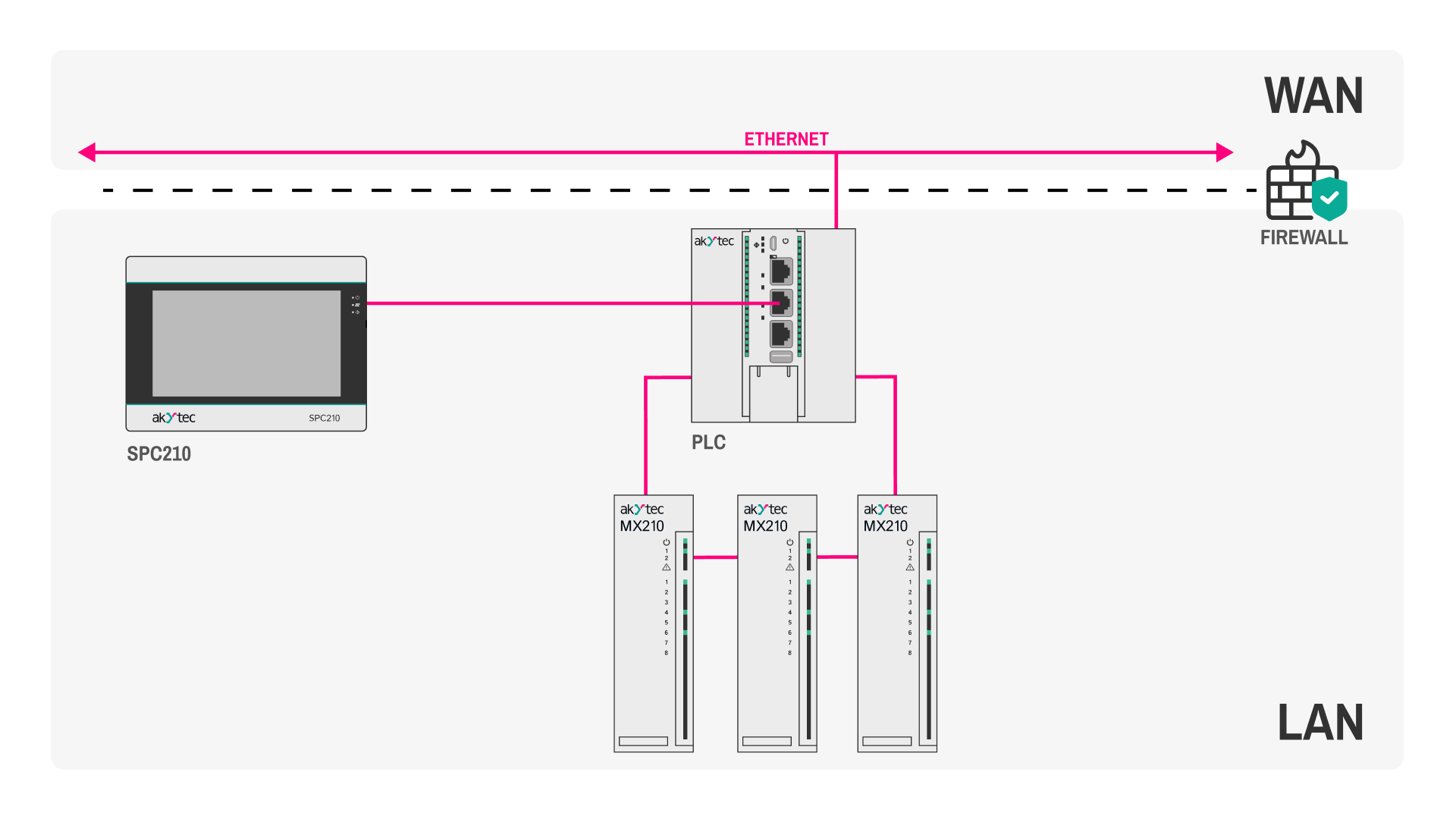 |
Ethernet 1, Ethernet 2, and Ethernet 3 ports are bridged to the local area network (LAN). Ethernet port 4 is used as a separate isolated network interface for WAN connection, protected by a firewall. This scheme allows the network to be divided into two zones, providing a single IP address space for Ethernet ports 1–3. |
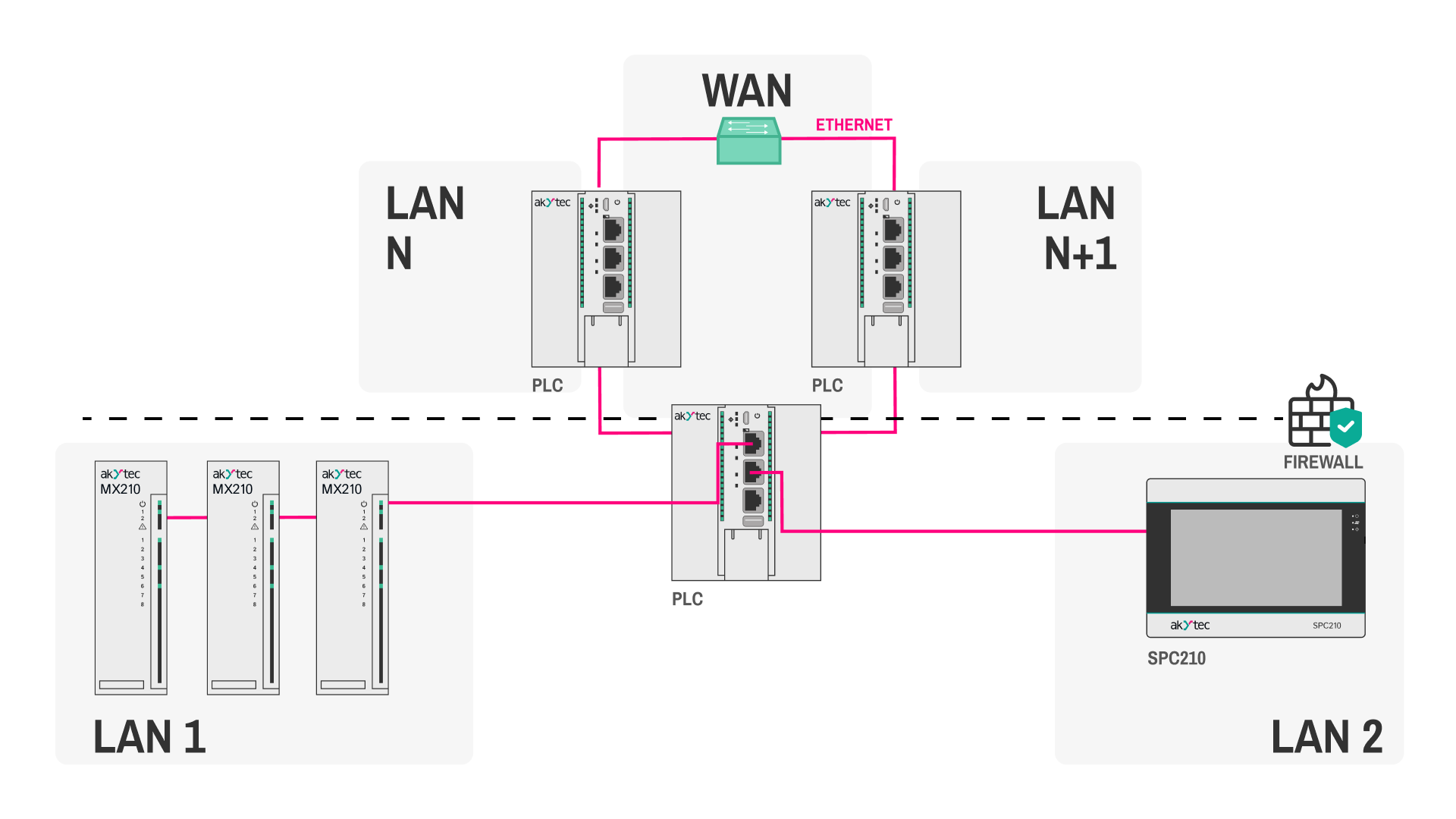 |
Ethernet 1 and Ethernet 2 ports are bridged to a firewall-protected Wide Area Network (WAN) connection. Ethernet 3 and Ethernet 4 ports are separate isolated network interfaces for local area network (LAN) connections. |
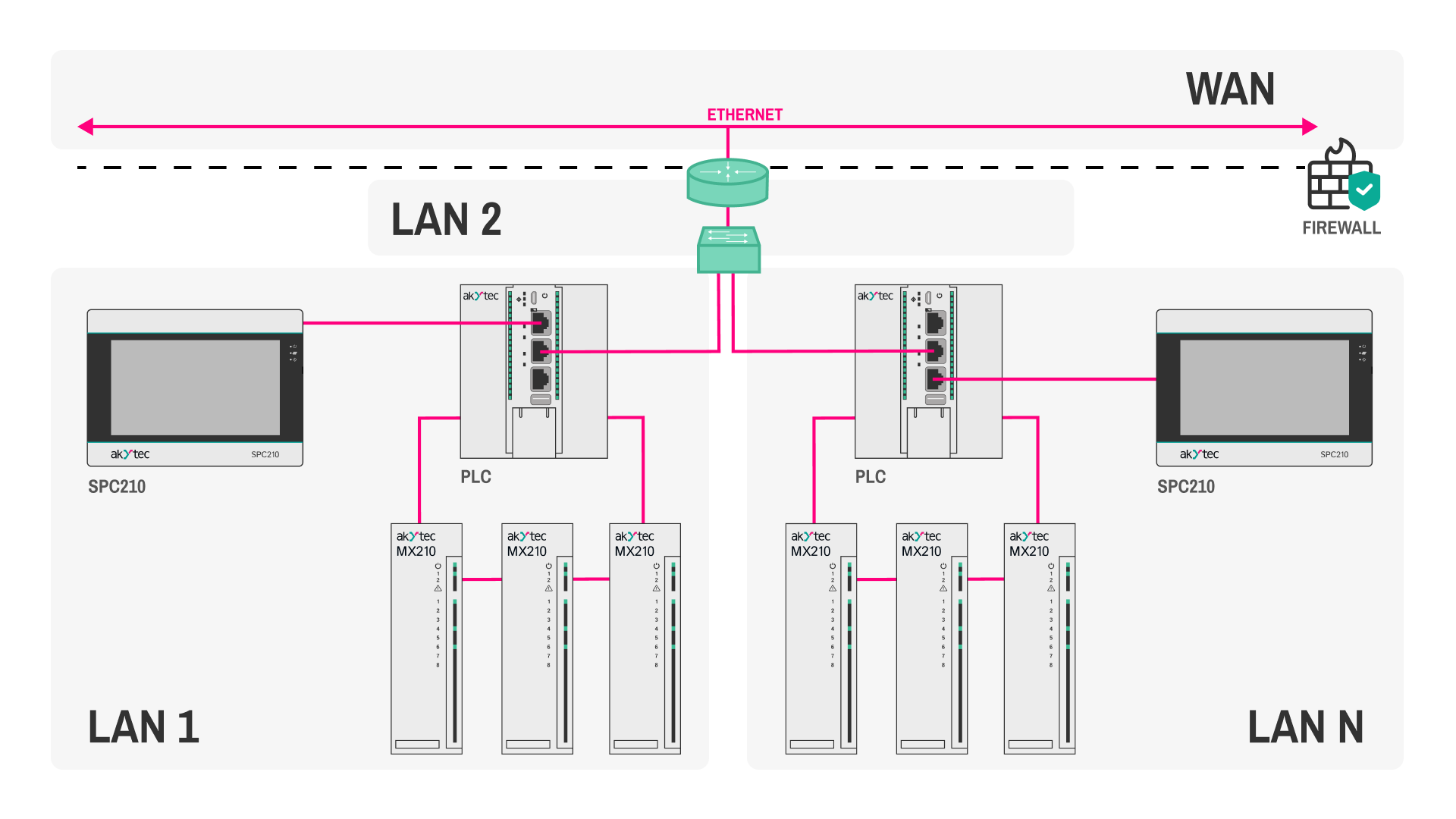 |
Ethernet 1, Ethernet 2, and Ethernet 3 ports are bridged to a local area network (LAN). Ethernet port 4 is a separate isolated network interface for connection to a separate local area network (LAN). |